2025-11-27 | Bridgestone Team
Studded Snow Tires vs. Studless Snow Tires
Driving in winter can be downright scary. Is your vehicle capable of handling ice, slush, and snow? The best way to be prepared for unpredictable winter roads is to install winter tires (also known as snow tires) on your vehicle.
If you’re in the market for winter tires, you have a lot of options to choose from. But how can you know which kind will suit your needs best? Start with the basics.
There are two main types of winter tires, studded and studless. Studded tires were the must-have snow tires for a long time, but advances in rubber compounds and other winter tire technologies have changed the minds of many drivers.
Studded Tires
Studded snow tires literally have metal studs embedded within the tread. These small, strong pieces of metal are designed to dig into ice, which provides added traction. When the driving surface isn't covered in ice, studded tires can damage the road. They're tough enough to dig into pavement, which is why many states limit their use during non-winter months and some states have outlawed them completely. Studded winter tires are also known to produce a noisy ride.
Although studded tires are capable of handling icy driving situations, improvements in the rubber compounds of modern studless winter tires have made them more capable of handling some of winter's most extreme driving situations.
Studless Tires
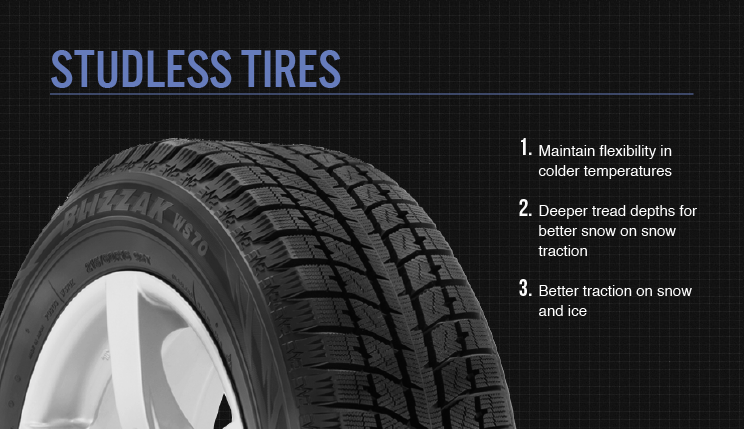
In recent years, studless snow tires have become the preferred snow tire for many winter drivers. Instead of relying on metal protrusions in the tread, modern non-studded winter tires lean on advances in rubber compounding, tread designs, and other unique technologies.
In winter's cold temperatures, a non-winter tire's tread rubber becomes stiffer and less able to conform to even a dry road's irregularities. Modern studless snow tires are capable of maintaining flexibility in freezing temperatures, thanks to advances in rubber compounding technologies. This increased rubber flexibility allows tires to maintain traction on snowy, icy, wet and dry driving surfaces.
Studless winter tires generally have deeper tread depths than summer or all season tires. Deep tread depths allow the tire to manage snow and slush dispersion from under the tire. It also allows the tire to provide better or snow-on-snow traction by packing it within the tread blocks.
Another feature you'll notice are thousands of tiny slits in the tread pattern, called sipes. These act as thousands of biting edges on ice that help with acceleration, deceleration, and stopping.
The choice between studded vs. studless snow tires ultimately depends on your preference, although breakthroughs in winter tire technology have nearly eliminated the need for studs.
Did you know Bridgestone is a leader in winter tires? Blizzak studless snow tires are specially engineered with unique tread patterns, deep tread depths, and industry-leading snow and ice technologies. Zig zag sipes in Blizzak tires provide a multitude of biting edges that provide confident grip in snow and ice. Proprietary rubber compound technology, called Tube Multi-Cell, removes the thin layer of water from under the tire, which is typically the main cause of slippage.
Ready to find the Blizzak tire for your car? Start here.
-
Brigestone Turanza 6 Thế hệ mới - Dòng lốp "EV-ready"
Brigestone Turanza 6 Thế hệ mới - Dòng lốp "EV-ready"
Bridgestone Turanza 6 Thế hệ mới được trang bị công nghệ tiên tiến ENLITEN, giúp dòng lốp này đạt chuẩn “EV-ready”, chứng nhận cho khả năng vận hành tối ưu trên cả xe điện và xe xăng.
Xem thêm -
Lốp xe tiết kiệm nhiên liệu
Lốp xe tiết kiệm nhiên liệu
Hãy xem dòng lốp tiết kiệm nhiên liệu của Bridgestone sẽ giúp bạn tiết kiệm chi phí, tăng quãng đường di chuyển trên từng lít nhiên liệu, mang đến cảm giác thoải mái và giảm lượng khí thải như thế nào.
Learn More Xem thêm -
Winter and Snow Tires
Winter and Snow Tires
If you live in an area that experiences snowy or icy conditions in the winter months, hitting the road means paying close attention to conditions and adjusting your driving accordingly. But possibly the most important thing to do is install winter or snow tires.
Learn More