2025-11-27 | Bridgestone Team
Winter Driving Safety Tips
As the weather turns cold, are you prepared to face the hazards of winter driving? Drivers should brush up on their winter driving skills each year and remember these easy winter driving tips.
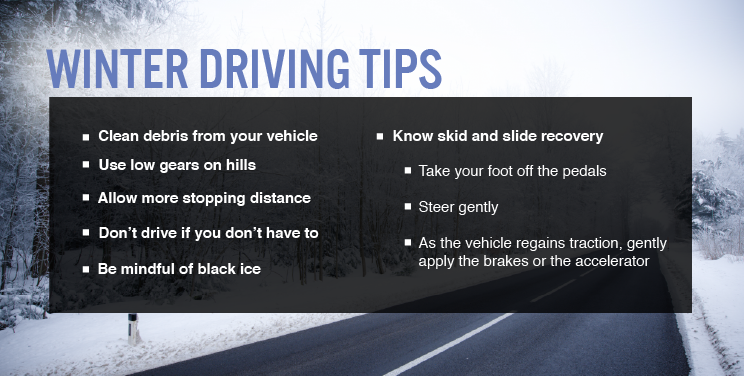
Clean all debris from your vehicle
Before you get behind the wheel, it’s important to remove all snow and ice from the windshields, windows, tops, and sides of your vehicle – yes, all of it! Don’t forget to clear any ice blocking your exhaust pipe lest fumes leak back inside the vehicle.
Use low gears on hills
Low gears offer more traction on hills. Vary your speed and gear use very deliberately in winter weather to maximize traction and minimize the possibility of slides or skids. This also means you should almost never use cruise control on snow or ice.
Drive slowly and allow more stopping distance
Even with snow tires, your vehicle may require more distance to stop than it would in dry conditions. A good rule of thumb is to allow three times the amount of stopping distance in snow or ice than on a dry road. Excessive speeds make it difficult to achieve this. Don’t stop if you don’t have to, especially on hills. The more often you have to start moving from a complete stop, the more often you risk getting stuck.
Don’t drive if you don’t have to
If you don’t have to drive in the snow, don’t. It’s dangerous. However, if there’s just no other option, stay focused on the road and be prepared for unexpected hazards. Check the weather forecast, too. Knowing the conditions you’re likely to encounter can help you prepare accordingly.
Be mindful of black ice
It might look like a puddle, but it isn’t. It’s ice. And it can cause you to lose control. Remember that if a road looks slick, there’s a good chance it is. Maintain a slow speed and test any possible black ice patches by turning your wheels slightly or lightly applying the brakes.
Know skid and slide recovery procedures
Whether you’re in a front-wheel or rear-wheel skid, the following procedures will help you regain control of your vehicle:
- Take your foot off the pedals. Neither the accelerator nor the brake will help you in a skid. If anything, they could make it worse.
- Steer gently in the direction you want to go. Common skid recovery advice is to steer “in the direction of the skid,” but in a real skid you may not have time to think through the situation so carefully.
- As the vehicle regains traction, gently apply the brakes or the accelerator. This is where front-wheel and rear-wheel skid procedures differ slightly. In a front-wheel skid, gentle pressure on the brakes will help you regain control. However, in a rear-wheel skid, slowly accelerating will achieve the same.
Recovery procedures for full-on vehicle slides are similar. Remove your feet from the pedals and steer gently in the direction of intended travel.
-
Vượt đèn đỏ phạt bao nhiêu? Mức phạt & điểm trừ GPLX ô tô, xe máy 2026
Vượt đèn đỏ phạt bao nhiêu? Mức phạt & điểm trừ GPLX ô tô, xe máy 2026
Lỗi vượt đèn đỏ ô tô mới nhất 2026 phạt từ 18 - 20 triệu, trừ 4 điểm GPLX, xe máy phạt 4 - 6 triệu, trừ 4 điểm GPLX (đối với TH không gây tại nạn).
Xem thêm -
Audi A4 2026 giá mới nhất T10/2026: Đánh giá nội - ngoại thất & động cơ
Audi A4 2026 giá mới nhất T10/2026: Đánh giá nội - ngoại thất & động cơ
Audi A4 được phân phối chính hãng theo hình thức nhập khẩu nguyên chiếc, nổi bật với thiết kế sang trọng, công nghệ hiện đại và khả năng vận hành ấn tượng.
-
Bảo hiểm 2 chiều ô tô là gì? Mức phí, quyền lợi, điều kiện bồi thường
Bảo hiểm 2 chiều ô tô là gì? Mức phí, quyền lợi, điều kiện bồi thường
Bảo hiểm 2 chiều xe ô tô, còn được gọi là bảo hiểm toàn diện bao gồm bảo hiểm TNDS và vật chất xe, chi trả cho cả người mua bảo hiểm và bên thứ 3 khi xảy ra sự cố.